Posted 2/13/09
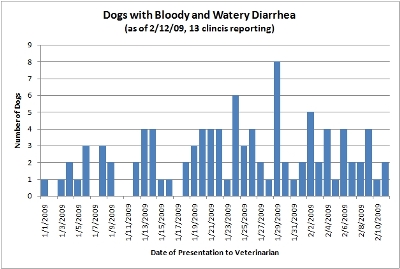
Between January 1 an February 13, veterinarians
in Los Angeles County at 13
veterinary practices reported 99 cases of either
bloody or watery diarrhea in dogs
Of these cases, 82 also had vomiting. Half of the cases
recover within five days and half take longer to recover
or have a waxing and waning disease course. At
least 29 cases required intravenous fluid treatment,
while others required less intensive care. Most
cases were treated by veterinarians with antibiotics and
anti-nausea or anti-vomiting drugs.
Los Angeles County has an estimated
1.9 million dogs, so this outbreak is affecting a very
small proportion of the population.
Outbreaks of bloody diarrhea in dogs
were reported in four out of the five winters
before 2009 in Los Angeles County, suggesting that seasonality may
play a role. There was no evidence to link this
to the peanut-butter paste Salmonella outbreak. Salmonella cultures
were reported on 12 dogs
and all were negative. Tests for several other
infectious agents were also performed, and did not
revealed a clear answer. There is no evidence that
any food contamination played a role, because
the dogs had been eating a wide variety of foods.
In the majority of cases (89.5%), no
other pet in the house was reported to have the same
illness, so this condition did not appear to spread
easily from dog to dog. This condition also did
NOT appear to spread from dogs to people.
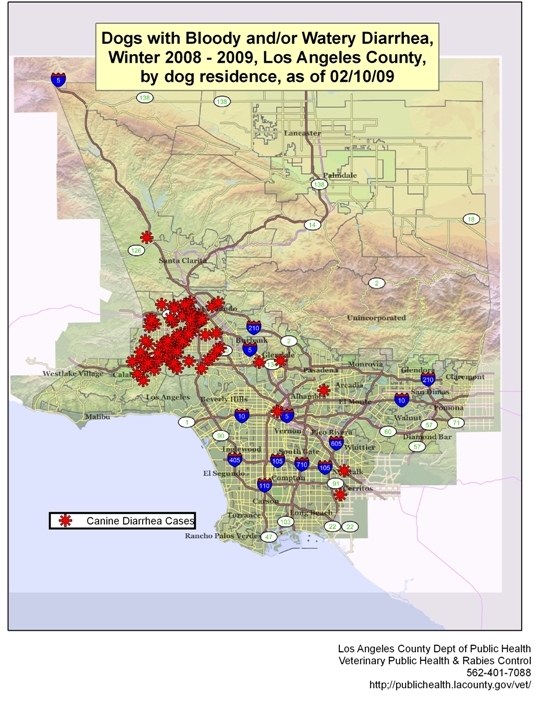
Most cases were reported
from the San Fernando Valley area, with sporadic cases
being reported from around the county.
Veterinarians are encouraged to report cases in
order to help better track patterns that may reveal a
cause.
Canine Diarrhea and HGE Case Reporting Form

Printable version of update
___________________________________________________________________________________________
Hemorrhagic Gastroenteritis (HGE) and Watery Diarrhea
Outbreak in Dogs
(Posted 2/5/09)
Since January 21, 2009,
Veterinary Public Health has received reports from
several veterinary clinics that they were seeing an
increasing number of dogs with watery and bloody
diarrhea. As of January 30th, 2009, 53 official
reports have been received, with an estimated 120 or
more cases being seen at four veterinary clinics in the
San Fernando Valley since January 1st.
The first 29 case reports were reviewed. The primary
symptoms have been diarrhea (96.6 %) and vomiting
(75.9%), with about half having bloody stool. Recovery
rate has been variable, with about 20% having a waxing
and waning of symptoms. The average age was 5 years,
with a range of 2 months to 13 years. About half were
small breed dogs.
Locally, increases in Canine Hemorrhagic Gastroenteritis
(HGE) have been report during the winters of 2004, 2005
and 2006. Veterinary Public Health gathered reports and
tested many stool samples during previous outbreaks, but
was not able to identify a definitive cause. With the
clustering of reported cases, it is suspected that a
contagious infection or food contamination may be
causing these illnesses. Preliminary investigation of
these cases, and similar cases from previous years, has
not yielded any definitive evidence of bacterial or
viral infection. Studies are on-going, but there is no
evidence to date that this outbreak is linked to the
current Salmonella outbreak in people.
Veterinarians who see potential cases of HGE are
requested to complete the attached “Canine Diarrhea and
HGE Report Form” and fax it, along with relevant
laboratory reports, to our office (fax# 562-401-7112).
Please let us know if we can contact the dog owner to
obtain additional information if needed. We may contact
you about submitting stool specimens, as we attempt to
determine the cause of the outbreak.
Many thanks to
Dr. George Cuellar of the
Southern California Veterinary Hospital and Dr. Nada
Khalaf of VCA McClave Animal Hospital for reporting this
outbreak. Participation by local veterinarians is
essential to make our local animal disease surveillance
effective, and such reports are a value to the entire
animal health community.
2009 Canine Diarrhea and
Hemorrhagic Gastroenteritis Information Sheet
2009 Canine Diarrhea and HGE Case Reporting Form
.
Sample link