Slow Streets Program
Los Angeles County Launches Slow Streets
Program
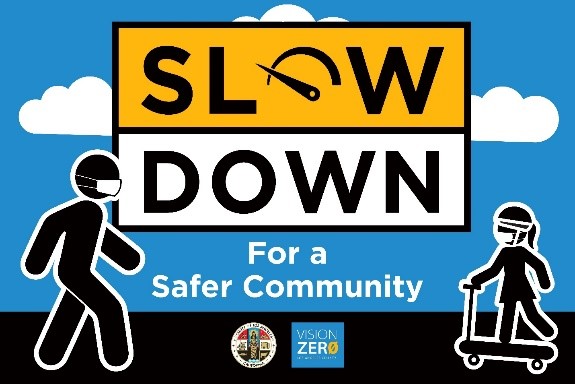
To make it easier for people to safely exercise and commute during the COVID-19 pandemic, Los Angeles County has launched the
Slow Streets program for unincorporated areas. Slow Streets is a temporary program aimed at alerting drivers to slow down making it easier to walk, bike, or roll while physically distancing.
As part of the program, Los Angeles County Public Works will install temporary signs with “Slow Down” messaging, free of charge, on qualifying streets.
Individual residents, community groups, or other organizations can sponsor a slow street network by visiting
VisionZeroLACounty.com and submitting an
application. To be eligible for signing, streets must be local residential streets, and part of a network of neighborhood streets that can also be signed.
Slow Street Sponsor responsibilities include, promoting the purpose of the program to fellow residents; notifying LA County Public Works if the signs or equipment posts are missing, broken, or vandalized; and communicating with the County if people are gathering/not social distancing.
Slow Streets is part of the County’s efforts to promote streets that are safer for physical activity and active transportation. Between 2013 and 2017, traffic fatalities on unincorporated County roadways increased by nearly 28 percent. The Board of Supervisors has adopted a Vision Zero Action Plan to eliminate traffic-related deaths and severe injuries on roadways in unincorporated areas of the County.
For more information on Slow Streets and Vision Zero, please visit
www.VisionZeroLACounty.com or call 833-VZ4-LACO (833-894-5226). For more information on COVID-19 in Los Angeles County, visit the
County's COVID-19 Response website (http://covid19.lacounty.gov).
LA County Board of Supervisors Adopts Vision Zero Action
Plan
Between 2013 and 2017, over 3,400 people lost their lives in traffic collisions on roads throughout Los Angeles County. Of these deaths, 383 occurred in unincorporated areas of the County. During this same time, traffic fatalities on unincorporated County roadways increased by nearly 28 percent.
In an effort to enhance traffic safety, the Board of Supervisors
approved a motion on August 4, 2020 authored by Los Angeles County Supervisor Hilda L. Solis, and co-authored by Supervisor Janice Hahn, to adopt Vision Zero Los Angeles County: A Plan for Safer Roadways, which establishes a goal of eliminating traffic fatalities in unincorporated areas of the County by 2035.
The motion directed Los Angeles County Public Works and Public Health to co-lead implementation of the action plan by forming a Vision Zero Steering Committee, launching pilot programs on three or more Collision Concentration Corridors, and providing an annual Vision Zero progress report. Learn more about the County’s Vision Zero program
here.
Articles & Research
A Novel Resident
Outreach Program
Improves Street Tree
Planting Outcomes in Los
Angeles (December 2022)
Urban tree planting is a
key climate change
resilience strategy for
many municipalities, but
remains challenged by
establishment mortality
in semi-arid regions.
Street trees offer shade
benefits to adjacent
structures and pavement,
and enable public works
departments to implement
heat island reduction
interventions to exposed
communities.
But in Los
Angeles, resident
approval and written
agreement to water for
3–5 years is required to
plant street trees in
residential public
rights of way.
Historically, 10% of
residents contacted
agreed to adopt street
trees, and 50% of trees
planted survived.
Community engagement
strategies, shown to
improve tree acceptance
rates and survival
elsewhere, had not been
tested here.
California
State University,
Northridge consulted
with PLACE on "A novel
resident outreach
program improves street
tree planting outcomes
in Los Angeles," a
mixed-methods
evaluation
of a street tree
planting and public
education project in
2018 that incorporated a
novel youth outreach
strategy to engage
residents. The
evaluation identifies
multiple strategies to
inform future tree
planting projects,
increase street tree
acceptance and
establishment survival,
and support community
co-benefits.
Preventing Traffic Deaths - The Critical Role of Clinicians
Traffic collisions are a leading cause of death for both
adults and children in Los Angeles County. Clinicians
have an opportunity to support Vision Zero, a
multidisciplinary effort to end traffic fatalities in LA
County. In the
July 2019 issue of Rx for Prevention, DPH
describes concrete actions clinicians can take to
advance traffic safety including: engaging patients in
conversations about practicing safe transportation
behaviors, sharing their first-hand experiences about
victims of traffic collisions to promote culture change,
advocating for local policy changes, and encouraging
their patients to get involved with local advocacy
efforts.
How do pedestrians fare in motor vehicle collisions?
DPH used data from the Los Angeles County Emergency
Medical Services Agency trauma database to evaluate
outcomes for people hit by a car while walking. Over a
two-year period, 4713 people were hit and 235 of them
died – that’s two people per week (see
infographic).
People hit at speeds greater than 20 mph were more
likely to be injured, disabled or die than people hit
speeds under 20 mph (
see brief).
Direct costs of medical care for bicyclist and
pedestrian victims
To place in perspective the economic losses that result
from motor vehicle crashes, DPH calculated the minimum
direct costs of medical care for pedestrian and
bicyclist victims of motor vehicle collisions in Los
Angeles County. In 2014, direct costs were $63.4 million
(see
brief and
methods).